
Bevy of New Turf Fields in San Francisco open for 2026/2027 School Year

New turf field installed at Monroe Elementary School in San Francisco
Six San Francisco Unified schools opened brightly colored new turf fields as students headed back to school this year. Monroe, Malcolm X, Willie Brown, Sherman, Harvey Milk Civil Rights Academy, and New Traditions – all of these schools are now providing inviting, cheerful, and safer playing places to replace hard, unforgiving asphalt.
Of those schools, three are in areas of San Francisco that have historically served underserved communities in critical need of more resources and more green spaces to play. Monroe Elementary is in the Excelsior in the southeastern part of the city, home to a large Asian and Latino population. 86.8% of Monroe’s students are classified in SFUSD's combined low-income/English learner measure. Malcolm X is in the Bayview-Hunter’s Point, the center of San Francisco's African American community in the southeastern corner of the city. Malcolm X is a particularly high-needs school; 94.6% of its students are low-income and/or English learners. Rounding out the group is Willie Brown Middle School, which Malcolm X Elementary feeds into, along with students from the broader area. The three other schools, Harvey Milk, Sherman, and New Traditions, are in the Castro, NOPA, and Marina, respectively.
America SCORES is behind those new fields and has steadily been installing fields throughout San Francisco since 2013, when the very first one - a 3500 square foot space – debuted at Cleveland Elementary, also in the Excelsior. Drive through San Francisco today, and you’ll see close to 40 turf fields on public school playgrounds. Funding for these fields comes not only from SCORES, but also from school communities, individual donors, and, increasingly, the business community.
Leading up to the 2026 World Cup, Airbnb announced a $1.2M investment in San Francisco, Los Angeles, and Oakland communities to support the refurbishment of local soccer pitches across the state through its Host City Impact Program, including a $360,000 investment in San Francisco via America SCORES. Airbnb was the leading funder for new soccer pitches at Harvey Milk and Willie Brown this year. A third is planned at Bret Harte Elementary, also in the Bayview, in the late spring, timed to coincide with the 2026 Women’s World Cup.

Thrilled middle schoolers running on the new turf field at Willie Brown Middle School in San Francisco
Airbnb is partnering with SCORES’ 11-field "Safe Play Spaces Initiative.” Other partners include the Herbst Family Foundation, the Playing for Keeps Foundation, San Francisco Unified School District, Count Us In, and school-site parent-teacher associations.
Glenn Castro has worked at Harvey Milk Civil Rights Academy for 28 years, long enough to remember when the school had no exit doors on one side of the building and no field at all. This year, the school got a turf field, and the timing wasn't an accident. "Creating the soccer field at a time when it was really needed, timed alongside the World Cup," Castro said, "it all made the difference." Principal Mark Sanchez described the same stretch of months as something close to a citywide mood: "The World Cup and all the surrounding events brought and ignited the excitement of this entire community."
The excitement generated by the World Cup fueled an interest and passion for soccer throughout the country, topping even the excitement of the U.S.-based 1994 World Cup, which profoundly changed the course of soccer in the US, spawning the spread of the game and organizations like SCORES, working to democratize the game by providing free programming in under-resourced communities.
That sentiment is echoed by Danny Baldocchi, Public Policy lead for Airbnb. “Airbnb is proud to extend the FIFA World Cup’s impact well beyond the tournament to the local communities who hosted games and visitors from across the globe, especially San Francisco. This city is woven into the fabric of our company, and it is only right that we give back in a way that strengthens neighborhoods, expands outdoor recreation access, and creates lasting memories for the community years after the tournament.”
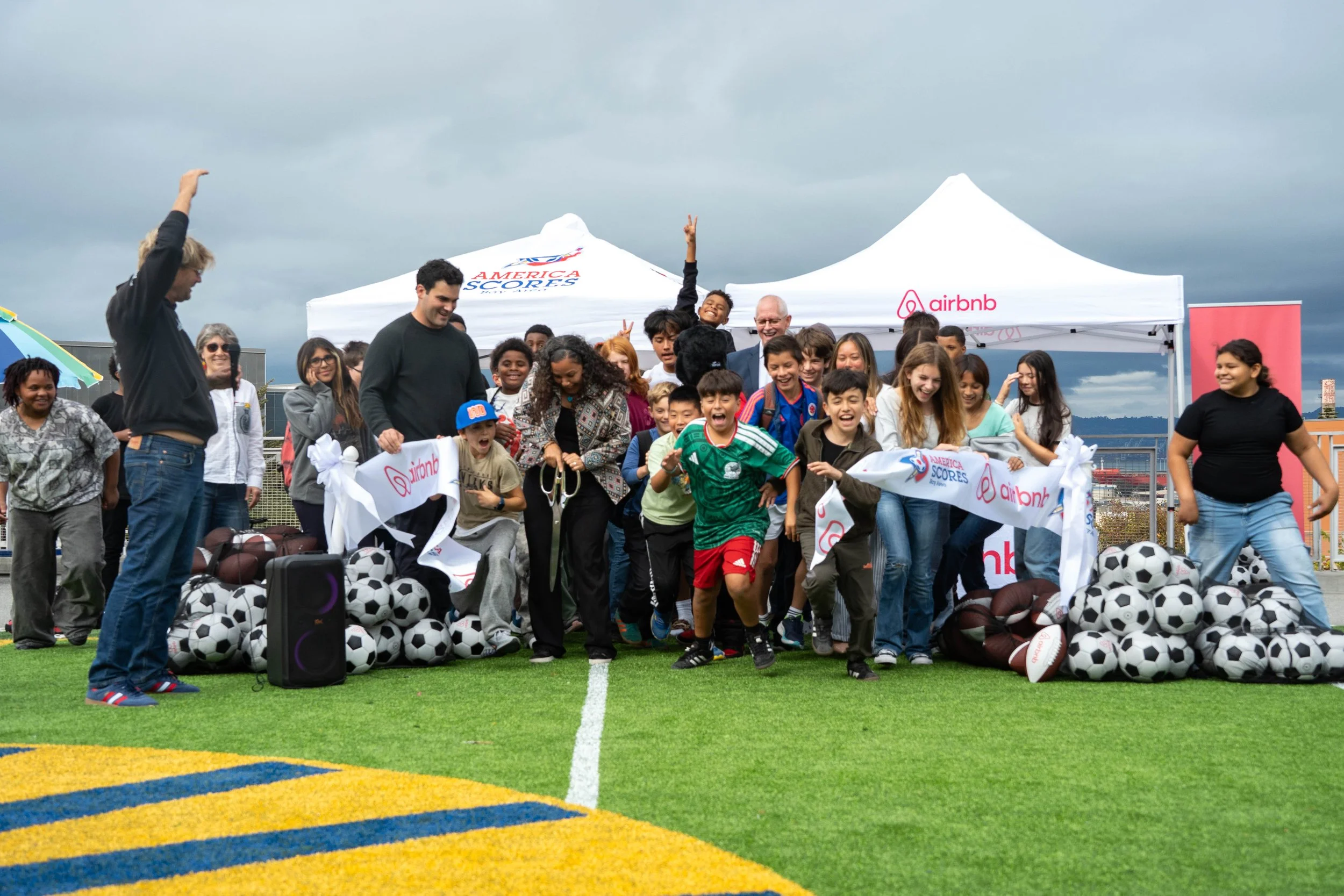
Airbnb’s Danny Baldocchi, Public Policy lead, at the Willie Brown Middle School field opening
WHY NOT JUST PLANT GRASS?
Turf fields have met some resistance from some within the environmental community. Their question – why not just plant grass? SCORES Executive Colin Schmidt has a direct answer. "If grass worked, I think almost everyone would choose grass," he said. "The problem is that for most urban public schools, it simply isn't practical." At Monroe Elementary, about 500 students share one playground every day — enough foot traffic to turn a new lawn into dirt, then mud, within a season. Kindergarten teacher Diana Puin Morell found this out the hard way. "I myself only had one day of beautiful grass for my children. By the time it was ready for my children to play on it, the gophers came and ate all the grass, and that becomes a hazard with the gopher holes."
So for a school like Monroe, the real choice was never grass versus turf. It was asphalt versus turf — a narrower, more practical argument than the one most people assume is happening.
NEW ARTIFICIAL TURF SYSTEMS – CHANGING THE GAME
Older artificial turf systems relied on loose crumb-rubber infill brushed between the blades for cushioning, and that infill migrated into soil, storm drains, kids' shoes, and eventually people's homes. It became one of the loudest environmental arguments against turf, and Schmidt doesn't dispute the legitimacy of those concerns.
The newer generation America SCORES has moved to is built by TenCate, a Dutch manufacturer that's spent decades engineering synthetic turf systems and has specifically targeted the failure points of the older material. Instead of loose infill, the cushioning is engineered directly into denser turf fibers, which is the piece meant to solve the migration problem. Instead of cutting a logo or mascot out of one section of turf and gluing it into another — the old method, and the point where fields historically wore out fastest — the design is now manufactured directly into the surface, with no seam to fail. At Monroe, whose mascot is the monarch butterfly, the school's positive-behavior symbol is built into the field this way. "The Monarch is special because it's all about growth and transformation," said assistant principal Susan Appe. "So now that message of growth and transformation is all over the school." Some of America SCORES' earliest fields, including the original one at Cleveland, have already held up for more than twelve years under constant daily use; TenCate's systems carry warranties built around lasting even longer.
Schmidt acknowledges the critics who believe plastics should be avoided wherever possible, including in turf. “I understand that perspective, but I also think it can overlook another important issue: what children actually need. Many urban communities don't have realistic access to large natural grass play spaces. So we have to ask a broader question. How do we create safe, healthy places for children to play with the resources and space that actually exist? That's why we've become involved with the Playing for Keeps Foundation. They've helped frame this discussion in a much more holistic way. Instead of asking only whether artificial turf contains plastic, they're asking much broader questions. How safe is it? How durable is it? How environmentally responsible is it? How affordable is it? How much access does it create? How much play does it enable? Those questions together paint a much more complete picture.”
And that picture includes considering play equity. Schmidt explains, “Play equity means recognizing that not every child has equal access to safe places to play. Children in many urban neighborhoods don't have backyards. They may not live near parks. School is where they run. It's where they play soccer. It's where they have recess. So when we think about playground surfaces, we're really talking about children's daily experience. That's why the Playing for Keeps Foundation talks about balancing several priorities at once. Environmental considerations matter. Economic realities matter. Safety matters. Access matters. Social equity matters. None of those should exist in isolation. The goal is to make informed decisions that balance all of them. That philosophy has influenced every decision we've made about the products we use.”
THE NEWEST FIELDS
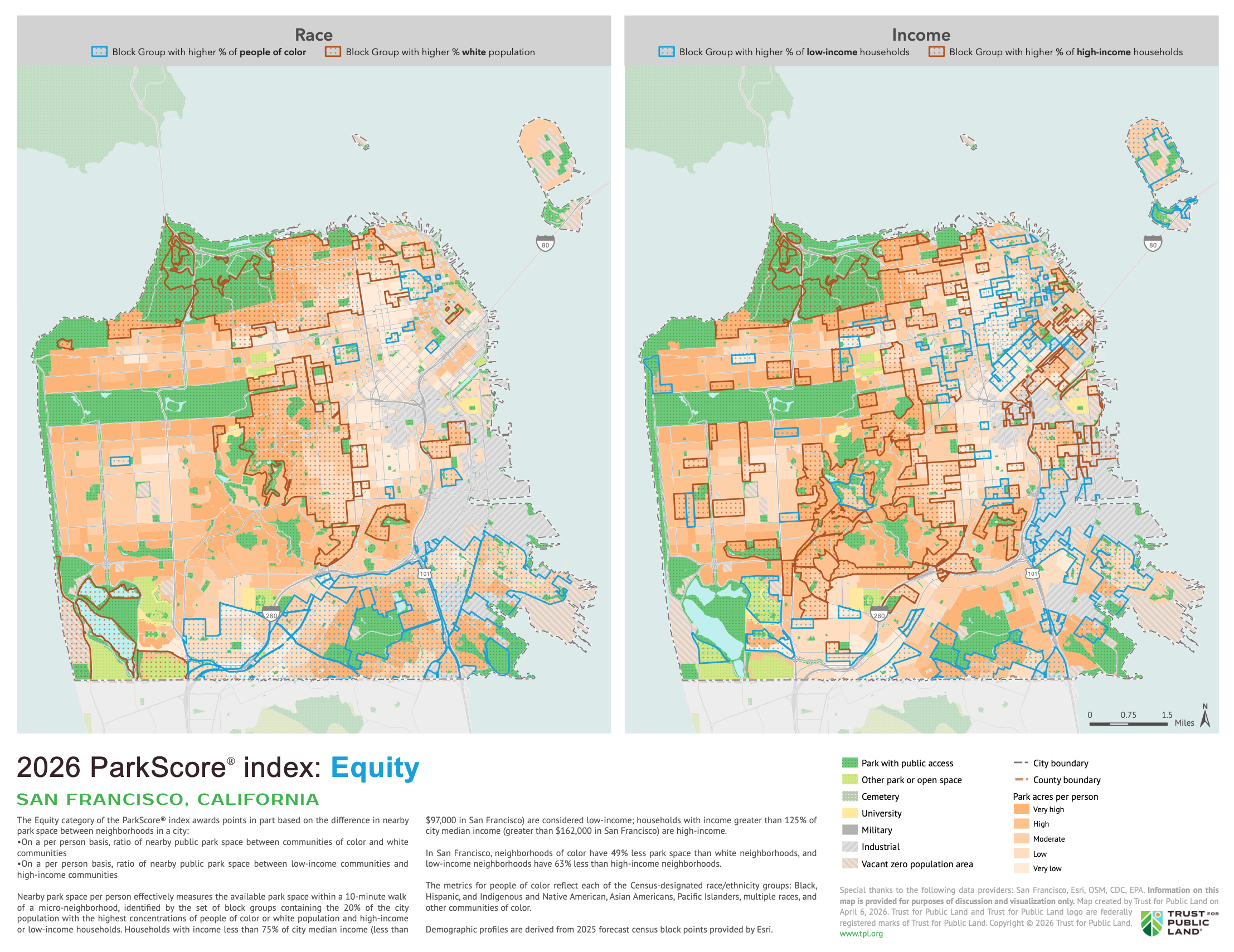
At Willie Brown Middle School in Bayview–Hunters Point, principal Malea Mouton-Fuentes described years of students playing soccer and tag football in a driveway or a corner of the yard because there was nowhere designated for it. "It really wasn't equitable," she said. "We needed a space for all kids to be able to have a place to play." Mouton-Fuentes grew up in Bayview, which has less park space per resident than most of San Francisco.
*See the Trust for Public Land’s ParkScore Index: Equity
"There's a need for more green spaces, more free space for young people to play. It's so important for our minds and bodies and spirits, our mental well-being and wellness.” And that wellness goes beyond sport. Mouton-Fuentas pointed to a math class that had gone out to the new field when the group needed a break. “The teacher commented on how refreshing it was to see the students simply lying out on the field and observing the sky. This field is so much more than turf; it’s a space where our students will learn teamwork and build friendships. Thank you for investing in our students – the impact will be long-lasting.”
Christine Tohuko, Willie Brown’s athletic director, described the school’s athletics program as bringing students from different grade levels, friend groups, and backgrounds together to build not only their athletic skills, but character and life skills. “When I look at this new beautiful turf field, I see community, I see safety, and I see fun.”
Malcolm X principal, Kerri Seo, was struck by the bright, happy colors of the new field. She described years of the school being overlooked and the difference the new field makes. “It’s overdue. People often come to our school and say it’s like we’ve been stuck in time, neglected, with older equipment that hasn’t been fixed that other schools replaced long ago. But this is beautiful, and I’d love it to be a shared space with the community around the school. We could have families using it here in the evenings and on the weekends or rec sports that don’t have access to space anywhere else. I’d love for that to happen, because we’re a community school.”

Malcom X Academy Elementary School Principal Kerri Seo and SCORES Executive Director Colin Schmidt on the new turf field
At Monroe, Principal Telmo Vasquez ties the field to World Cup energy. "We think that this new field is perfect for our students having just come off World Cup fever. We have students from different countries, different language backgrounds who are going to be coming and excited to represent their country."
Harvey Milk Principal Mark Sanchez underscores who specifically misses out with exclusively asphalt playgrounds. "Often girls won't engage in a lot of sports on a blacktop," he said, "but with the new turf field, more of our girls are out here playing soccer and competing." That’s music to Schmidt’s ears. SCORES champions girls in soccer through its dedicated initiative, Girls in the Game, which provides free soccer programming aimed at bringing gender equity to the sports field.
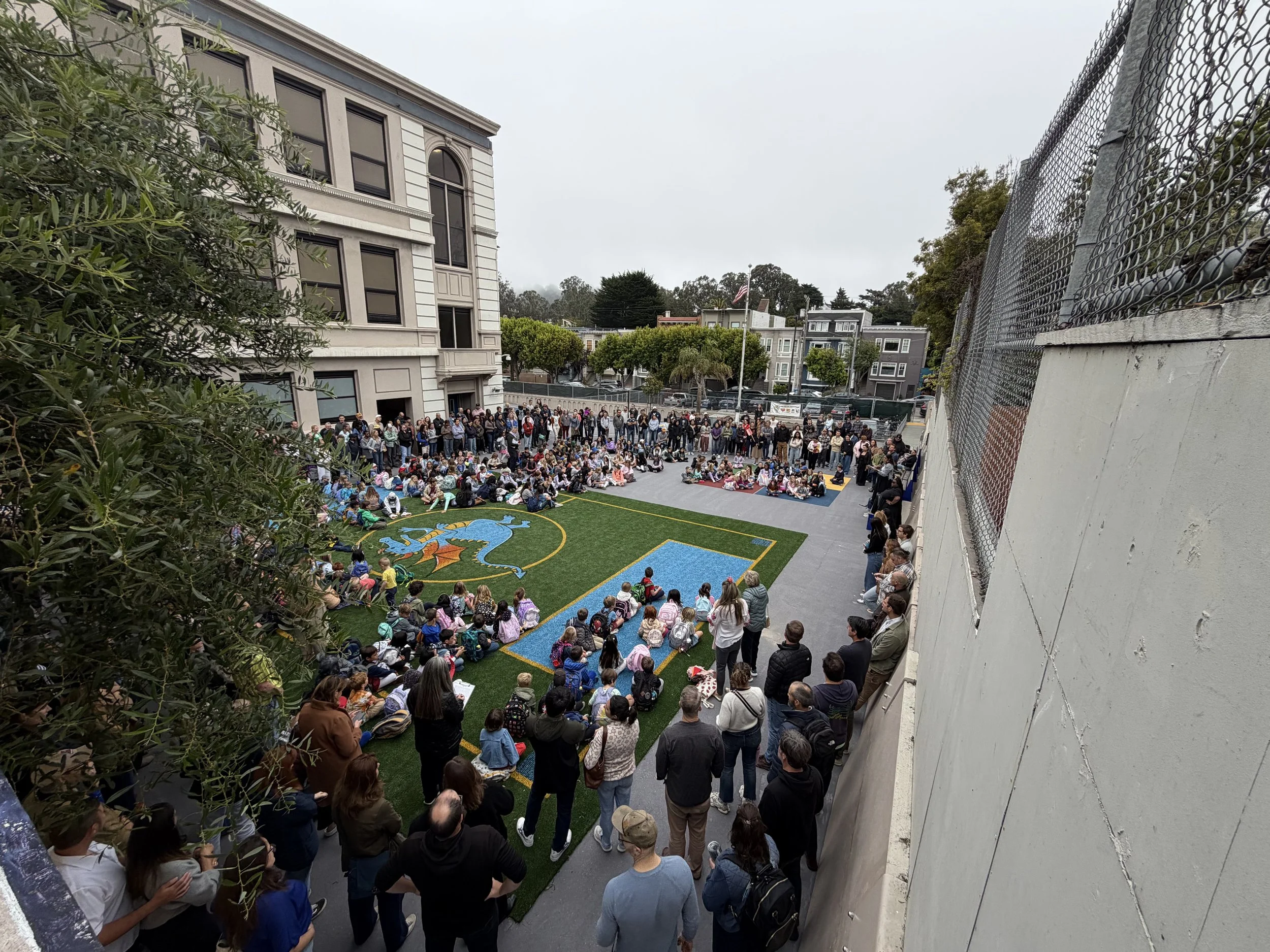
Kids and their families at the opening of the new turf field at New Traditions Elementary in San Francisco

SCORES Executive Director Colin Schmidt and Pansy Yip and Danny Baldocchi of Airbnb happily at play on a new field