Lindsey Jones
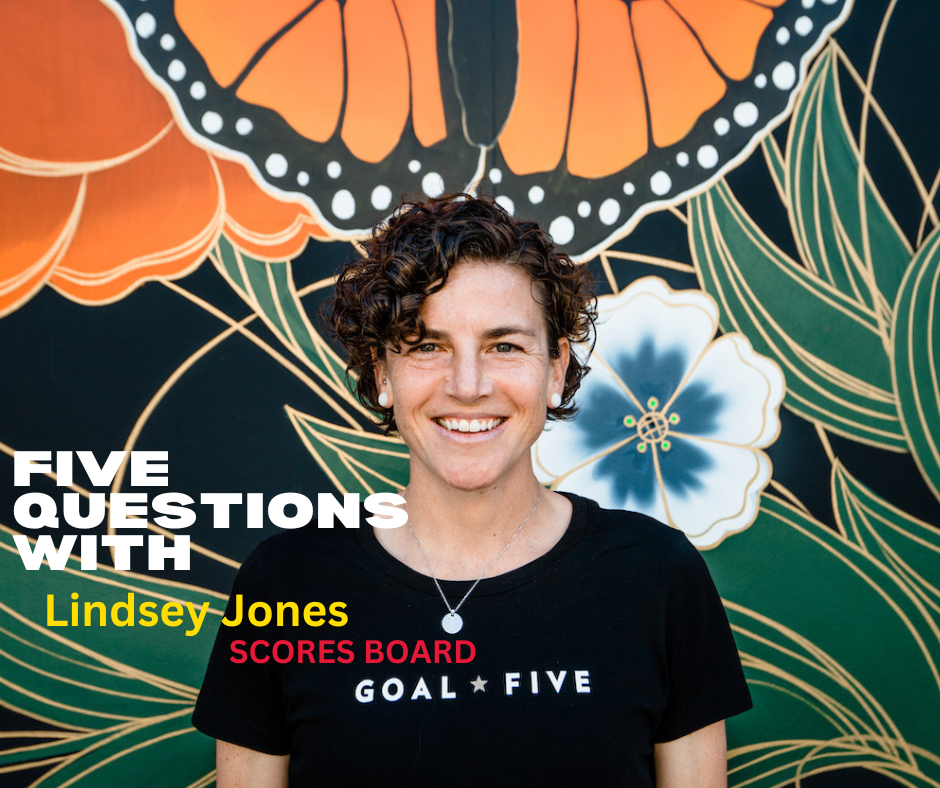
Lindsey Jones grew up in South Bend, Indiana, played soccer at Notre Dame, and competed professionally in the U.S. and Australia during the early iterations of what is now the National Women’s Soccer League (NWSL). When those leagues folded, she turned to building: a youth empowerment nonprofit in Oakland that has been operating for over fifteen years; a women’s soccer apparel brand designed to celebrate and elevate female athletes; and a career at the forefront of college athletics during one of its most consequential periods of change.
In 2026, she was named Associate Athletics Director of Business Development at UC Berkeley, after leading Stanford’s name, image, and likeness (NIL) strategy within the athletic department. She joined the America SCORES Bay Area board in 2026. While we usually ask five questions of our subjects, we went with six for Lindsey.
You grew up in South Bend, Indiana. Describe it for us.
South Bend was an idyllic place to grow up, with the University of Notre Dame giving it a bit more energy than your typical small Midwestern town. I grew up in an old historic home in a neighborhood with a lot of character, and my parents were deeply embedded in the community.
What stuck with me wasn’t just the work they did, it was how they did it. My dad was constantly out in the community through his role at the bank, and my mom was heavily involved in philanthropy and community organizations. You could see their impact in tangible ways like projects and initiatives, but more importantly, in relationships that lasted decades.
That combination – real work and real connection — shaped how I think about impact.
You were a serious soccer player at Notre Dame and then played professionally. What was that like?
I hadn’t planned on staying in South Bend for college, but the opportunity to play at Notre Dame was hard to pass up. We competed in multiple national championships, which is what you train for as an athlete.
It was also a very different era than today’s college landscape. There was less movement, more continuity, and the relationships you built with teammates and the institution really stuck. My Notre Dame teammates are still some of my closest friends.
After college, I played professionally in the U.S. and Australia. It was an incredible experience, but the early leagues didn’t have sustainable business models, and both folded pretty quickly. I remember being in Australia thinking, “I guess it’s time to start my real life.”
What’s exciting now is seeing the growth of women’s sports and the NWSL as a stable third iteration. It’s what we all hoped for back then.
Upward Roots, the Oakland youth nonprofit you founded, has been running for fifteen years. Where did the idea begin?
The idea started in college, in a course where we had to design and test a program in the community. I piloted something through the Robinson Community Learning Center focused on youth-led service.
At first, I thought I needed a hook, so I brought in Notre Dame football players to attract kids. But what I realized quickly was that the real impact wasn’t meeting the athletes — it was the experience of doing the work themselves. Cooking meals, cleaning parks, showing up for their own community — that’s what stuck.
After my playing and coaching career, I came back to that idea and built Upward Roots. The goal was simple: give young people the tools to identify issues in their own communities and take action. Not outsiders coming in to “fix” things — but empowering the people closest to the problem.
Fifteen years later, it’s still running, which is pretty special.
Much of your career has been about making the case for women's sports as a commercial force, most notably as co-CEO of Goal 5. What problem were you trying to solve?
We were trying to challenge a pretty outdated mindset — that you design for male athletes and then just “shrink it and pink it” for women.
We were all soccer players, and the gap was obvious. Women were literally wearing Lululemon on the field because existing products weren’t built for them. So yes, we built an apparel brand, but it was really about something bigger — creating a community and proving that women’s sports had real commercial potential.
The name Goal Five comes from the UN Sustainable Development Goal focused on gender equality, so it was always mission-driven. And in a lot of ways, we were early to the wave we’re seeing now in women’s sports.
COVID made things challenging, and we ultimately sold the company, but the core thesis — that women’s sports are both culturally and commercially valuable — has only become more true.
The business of college athletics has been fundamentally restructured in recent years, and NIL — Name, Image, and Likeness — is at the center of it. What does that landscape actually look like for women athletes?
One thing that doesn’t get talked about enough is that women and Olympic sport athletes are actually thriving in NIL, in many cases more authentically than what we’re seeing at the top of football and men’s basketball.
A lot of those bigger deals are essentially pay-for-play. But true NIL — brand partnerships, storytelling, audience engagement — that’s where many female athletes really stand out. They tend to be more engaged and more aligned with the brands they work with.
The bigger question is what this means for gender equity long-term. NIL largely exists outside of Title IX right now, and at some point, those realities are going to collide. The revenue models driving the system are still heavily tied to football and men’s basketball, so there’s tension built in.
We’re still very much in the middle of that playing out.
What drew you to SCORES, and what do you hope to contribute?
I’ve crossed paths with SCORES in different ways over the years, but I was looking for something more hands-on, a way to engage beyond just showing up or supporting from a distance.
This felt like a natural fit. The mission aligns closely with the work I’ve done, especially around using sport as a vehicle for confidence, leadership, and community connection.
The two areas I’m most interested in are participation and service learning. Participation in sport, especially for adolescent girls, is declining, which is concerning given how much sport contributes to long-term development. And the service-learning model is something I’ve spent a lot of time around through Upward Roots — empowering young people to lead within their own communities.
It’s a strong alignment, and I’m excited to contribute in a meaningful way.
Read more Five Questions With stories here.