Francesca Bell
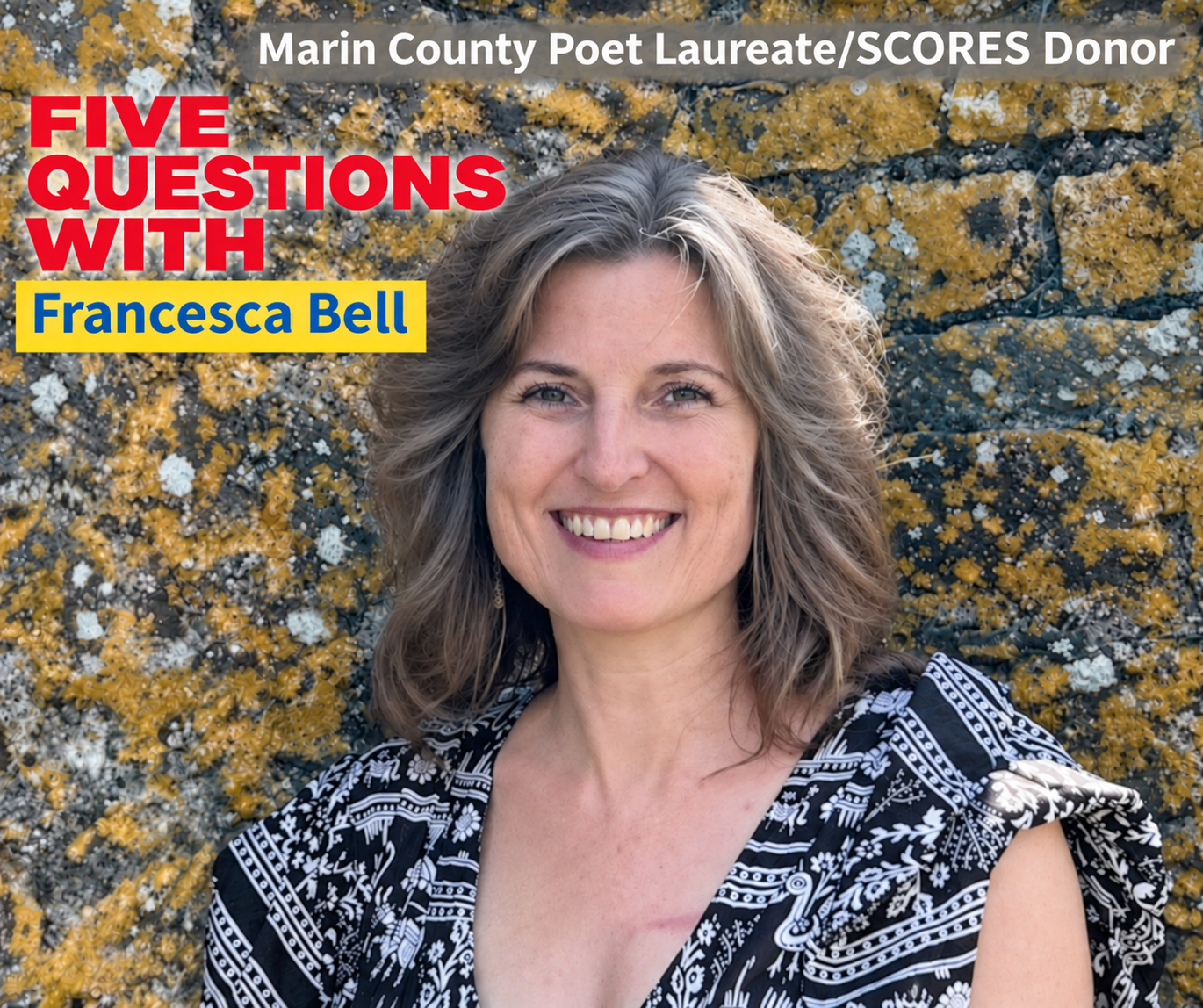
Marin County Poet Laureate (2023–2025), poet, translator, and SCORES donor
Francesca Bell was Marin County Poet Laureate from 2023 through 2025. She considers herself a confessional poet and writes from personal experience, finding rich material in the examination of loss, illness, family, the fallibility of the human body, and the things we struggle to face head-on. Francesca came to SCORES as a poetry slam judge in 2024.
As a laureate, she told the Marin Poetry Center that her goal was to share poetry “particularly with those who may not have had much exposure to it before — the unsheltered, those experiencing incarceration, children and others who may have simply never given poetry much of a try.” She’s met that goal, sharing her works in a range of spaces including public libraries and at San Quentin, where she’s taught poetry workshops.
In addition to contributing to numerous publications, she’s published two collections, Bright Stain (Red Hen Press, 2019) and What Small Sound (Red Hen Press, 2023), both finalists for the Julie Suk Award. Her translation of German poet Max Sessner’s Whoever Drowned Here was a finalist for the Northern California Book Award.
Francesca grew up in Washington and Idaho, a hungry learner and frequenter of the public library, but never completed middle school, high school, or college. She holds no academic degrees and has built her poetry career entirely outside of academia, where advanced degrees and formal mentorship typically pave the way to national publication
We spoke to Francesca this fall. These are lightly edited excerpts from our conversation
What does poetry give people — the people who write it and the people who read it?
I think people come to poetry, both the reading and writing of it, for different reasons. For children, what poetry often does is teach them what language can do, how you can play with it. It often rhymes, it’s very musical, it can be funny — think of Shel Silverstein. It can teach them about the beauty of language.
For me, when I was about twelve, I really discovered confessional poetry, where the poet writes about very personal things. And what poetry was for me then, and what I still go to it for, is a place where people tell the truth about how they’re feeling, about things that are ugly, about things that are painful. A good poem does that with more punch than prose, in part because of its brevity.
A lot of poets will say that poets can say the unsayable, though by definition, if you’re saying it, it has become sayable. But reading poetry is a way to feel less alone. If you’re reading a poet who is very honest about their feelings, very vulnerable, it helps you to not feel alone with your own feelings. And I think there’s a great intimacy that can occur between a reader and a writer even if they never meet each other.
“ Reading poetry is a way to feel less alone”
You discovered confessional poetry through Anne Sexton, at the public library, when you were twelve. What happened?
My family was having some issues, especially around substance abuse. Nobody talked about it. It was like nothing was happening, but then there would be big things happening. And I was edging into adolescence, having a lot of moodiness and feelings of depression and isolation.
When I read Anne Sexton, it was remarkable to me that here was a place where people talked about things. She wrote about mental illness, alcoholism, women’s bodies. All of that was really revolutionary in the sixties and seventies. And I was just beginning to have all these new feelings, and she wrote about them. So it was through reading her that I discovered the power of confessional writing. It showed me that I wasn’t alone, because it’s very easy to think that you’re the only person who has any complexity. And that just isn’t the case.
You judged a SCORES poetry slam in 2024. What did you walk into?
I had no idea what I was stepping into. I was told “poetry slam,” and I assumed these would be teenagers. So I was completely unprepared for how young the kids were.
What struck me first was the sheer enthusiasm of the children for poetry. A lot of the children were from immigrant families, and they wrote so proudly of their home countries. There were so many poems about food, especially foods they missed. There was one poem in Spanish that I couldn’t understand (though it was clearly a list poem about food from wherever this boy had come from) and the response was incredible – the room just roared.
There was so much warmth among the families. As an Anglo-American, I think we’re used to things feeling much cooler, colder even. All of the parents were there, the babies were there. Everyone was so happy to be together in the room. As a poet, when you go into rooms where people are going to do poetry, there’s usually not that much enthusiasm. In Marin County, it’s very often quiet, older people sitting in a room. And this was just babies crawling everywhere and kids who were so engaged. It was so warm and so familial.
I was also really impressed by the quality of the poetry. And that the kids had memorized everything.
That detail — the kids having memorized their poems — what does that mean to you as a poet?
I think it probably takes us back in a primal way to when human groups had oral traditions. And I think if you have a person who reads well, they’re also giving a performance of a type. Sometimes there will be very theatrical readers, but sometimes even just a quieter, more nuanced reading of something really helps the piece come alive.
Most modern poets don’t memorize their poems, and I think that’s partly because rhyme isn’t as favored now, and it’s much easier to memorize things that rhyme and have rhythm. There’s a poet named Anders Carlson-Wee who recites everything. He never reads from the book. And he has explained that he’s profoundly dyslexic, so it’s actually harder for him to read from the page in front of people than to simply memorize the poems. Because he had to develop these memory skills as a child, he can go for a walk and rearrange the entire order of poems in a manuscript in his head. And he really recommends it to other people.
You have chosen to donate to SCORES. What inspired you to give?
At that poetry slam, it was just very obvious what a difference the program was making in the kids’ lives. And the whole families were so invested in it, so nurtured by it. It’s a program that’s worth supporting.
And I find it funny that it’s soccer and poetry. There’s another organization called Soccer Without Borders, and the man who started it, Ben Gucciardi, is a really fine poet. There seems to be something about that combination of soccer and poetry. You’re physically expressive on the field, and verbally and creatively expressive in the writing. And moving — walking, running — is known to be very beneficial for your brain and for having ideas. So when you think about it, it makes more sense than it first appears.
To read more Five Questions With Conversations, go here!